 BloomIntegrated Health
Empowerment-Based Integrated Therapy
Empowerment that allows neurodivergent individuals to thrive as their authentic selves.
The core of our practice, in partnership with the Neurodivergent Empowerment Institute in our St.Petersburg offices.
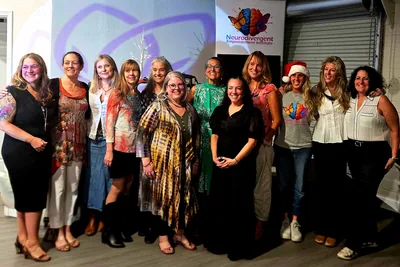
Open House at the Neurodivergent Empowerment Institute, December 2025
What's going on?
If you are autistic, the world is often too much. Too loud, too bright, too fast, too unpredictable, and too overwhelming in ways most people don’t even notice. The last thing you want is other people asking you what's wrong when you're feeling overwhelmed.
Maybe you learn to mask your own thoughts and reactions to avoid discomfort, exclusion or even bullying. Maybe you learn to imitate "normal" behavior to get by. Over time, 'coping' can compound into burnout, anxiety, and depression.
Where do we even start?
Autism evaluation — the records review, the family interview, and the interview with you — alongside cognitive testing when the picture calls for it. If you have spent years being told you were fine, or difficult, or both, the point of an evaluation is not a label. It is language for something you have been carrying without one.
We evaluate children, teenagers and adults. Whether you are the parent who has been wondering since preschool or the adult who has been wondering since school, it is the same building and the same approach.

The neurodivergent community also calls for greater inclusion and collaboration in therapeutic practices. Individuals and their families want to be active participants in defining therapeutic goals and strategies, ensuring that interventions reflect their unique values, needs, and aspirations.
Then what?
A neurodivergent support group, for the particular relief of not translating. Social-skills and sensory tools built on Dr. Fisher’s Empowerment-Based Integrated Therapy — whose spine is validation, acceptance and nurture, and which was written as a compassionate alternative to ABA. Role-playing-game therapy, for people who find it easier to practise being themselves through a character first.
And plain case management for accommodations and advocacy: the letters, the paperwork, the arguing with institutions that shouldn’t need arguing with. A great deal of what exhausts neurodivergent adults is administrative redundancy.

How do I start?
Book an assessment call with a Bloom practitioner.







Frequently asked
Do I need a diagnosis before I can start?
No. Plenty of people begin without one, and some never pursue one. Assessment is something we offer, not a gate you pass through to be taken seriously here.
I was diagnosed late — is that common?
Very. Late diagnosis is one of the most frequent reasons people come to us, and the work that follows it is often less about the wiring than about the years spent not knowing.
What actually happens in an autism evaluation?
A records review, an interview with you, and — where relevant — an interview with family, sometimes alongside cognitive testing. Your clinician will walk you through the sequence before it starts, including what it can and cannot answer.
Is EBiT the same as ABA?
No — it was written as an alternative to it. Empowerment-Based Integrated Therapy takes every behaviour as having a purpose and every trait as a natural variation, and supports a person’s strengths rather than sanding down their edges.
Sources
- [1] Fisher, A. — Empowerment-Based Integrated Therapy: A Compassionate Alternative to ABA (EBiT Series). The model’s validation / acceptance / nurture spine is the author’s own; described here as the practice describes it. ↩
- [2] Fisher, Angela. Empowerment-Based Integrated Therapy: A Compassionate Alternative to ABA (Empowerment-Based Integrated Treatment Series). Kindle Edition. ↩